

Special Education Needs and disabilities
Gloucester Academy is ambitious for all our pupils and we believe that there is no ceiling on what can be achieved by anyone, regardless of their circumstance or background. We are committed to providing a supportive and inclusive learning environment, giving every young person the opportunity to fulfil their potential now, and in the future.
The leaders at Gloucester Academy are leaders for all pupils, enabling our teachers to be teachers of all pupils. Gloucester Academy is committed to distributed leadership to secure the best possible provision and outcomes for pupils with special educational needs. We have the same ambition for all our pupils, and recognise the importance and impact of prioritizing our responsibilities to pupils with special educational needs.
We work in partnership with pupils and their families in identifying and providing for special educational needs. Where appropriate, we also work in partnership with other agencies. We recognise the importance of communication being inclusive, accessible and culturally sensitive to achieve effective partnership working.
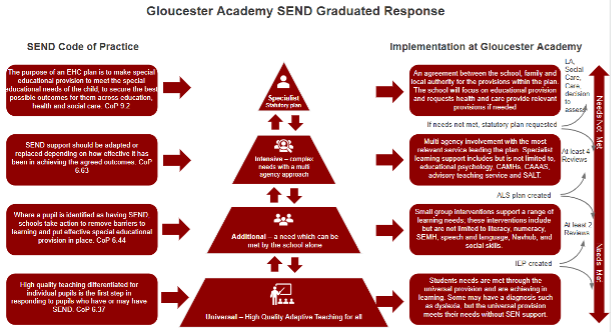
Graduated Response Diagram - GA Graduated response.pptx
What does it mean to have a Special Educational Need?
A pupil has SEN if they have a learning difficulty or disability that requires special educational provision to be made for them.
They have a learning difficulty or disability if they have:
-
A significantly greater difficulty in learning than most others of the same age; or
-
A disability that prevents or hinders them from making use of facilities of a kind generally provided for others of the same age in mainstream schools.
Special educational provision is educational or training provision that is additional to, or different from, that made generally for other children or young people of the same age by mainstream schools.
What this means at Gloucester Academy
At Gloucester Academy we believe that high quality teaching, delivered by mainstream subject experts, best meets the needs of all learners. The Local Authority holds responsibility for ensuring students can access our mainstream KS3 and KS4 curriculum, which is regarded as students approximately within three years of their age-related expectation.
All children, regardless of SEND status, are expected to make progress in line with Gloucester Academy’s high behavioral expectations. Children with EHCPs are provided with targeted support and challenge to make optimal progress. We actively teach and encourage self-efficacy in all learners, ensuring they can access wider club provisions, independent learning zones, and social avenues alongside peers through proactive, structural guidance.
Our SEND Team
Kevin Sinden, SENDCo
 I am incredibly excited to be part of the Gloucester Academy family. I have a passion for supporting students with special educational needs and thrive in ensuring students have the support and strategies in place to support their needs. I also enjoy delivering the training and providing advice to equip teaching staff with the knowledge and skills to ensure all our students can climb their mountain to the very best universities and professions.
I have worked in special educational needs for 19 years and have been fortunate to lead some of the largest special educational provisions in the country. Before working at Gloucester Academy, I was part of the leadership group at the City of Bristol College working as the Head of Alternative Learning Support. I have now been at Gloucester Academy for nearly three years and have had the pleasure of working with so many fantastic young people and teachers on our journey to providing the very best support for our students.
At the academy I teach Maths and King's Trust, having studied for my degree at the University of Gloucestershire and completed my teacher training through the University of Worcestershire.
Identification and assessment of children with SEND
Each student completes a variety of assessments when they join the academy. We assess baseline skills and levels of attainment on entry, actively building on information passed from primary transition frameworks and previous settings.
Class teachers make regular, systemic assessments of progress for all pupils to identify those whose progress matches the following criteria:
-
Is significantly slower than that of their peers starting from the same baseline.
-
Fails to match or better the child’s previous rate of progress.
-
Fails to close the attainment gap between the child and their peers.
-
Widens the attainment gap.
This assessment safely includes broader non-academic factors such as social and emotional regulation needs. Slow progress and low attainment do not automatically classify a pupil as having SEND. Where concerns are raised, teachers utilise our internal referral system to contact the SENDCO. In accordance with the graduated approach, referrals outline strategies already implemented natively in class along with their evaluated impact.
Parents and carers can also directly raise concerns with form tutors or by emailing the SENDCO at sendco@gloucesteracademy.co.uk. Deciding on special provision always starts with tracking desired outcomes, baseline wishes, and direct parental consultation.
Pupil Passport (IEP)
A pupil passport is a regularly reviewed document that contains the detailed needs, strengths, and individual strategies for every single student with an EHCP or on SEN Support. These are developed in direct partnership with pupils and their families, tracked and adjusted on a termly basis by an assigned keyworker, and instantly shared with staff to manage in-class adjustments.
Example Pupil Passport (anonymised)
Additional Learning Support Plans
Some pupils who require more specialised support will have Additional Learning Support plans to complement pupil passports. For example, an individualised learning plan will be used to:
-
Track progress against long-term outcomes in Educational, Health and Care Plans (EHCNAs) for pupils working below age related expectations
-
Inform medium-term and daily curriculum planning and provision where children are accessing adapted curriculum pathways
-
Inform intervention planning
Universal provision – high quality teaching
Gloucester Academy ensures that universal high-quality teaching is designed to organically address gaps in foundational knowledge. Through evidence-informed routines, teachers actively target vocabulary, reading fluency, and cognitive processing. Classes are explicitly scaffolded, and students are streamed across core lessons to support adaptive delivery.
Key classroom tenets include; Teaching to the Top; (maintaining premium expectations while modifying delivery), lowering overall cognitive load, providing explicit instructions, and maintaining a high ratio of in-class checking for understanding.
Targeted support (Wave 2 and Wave 3)
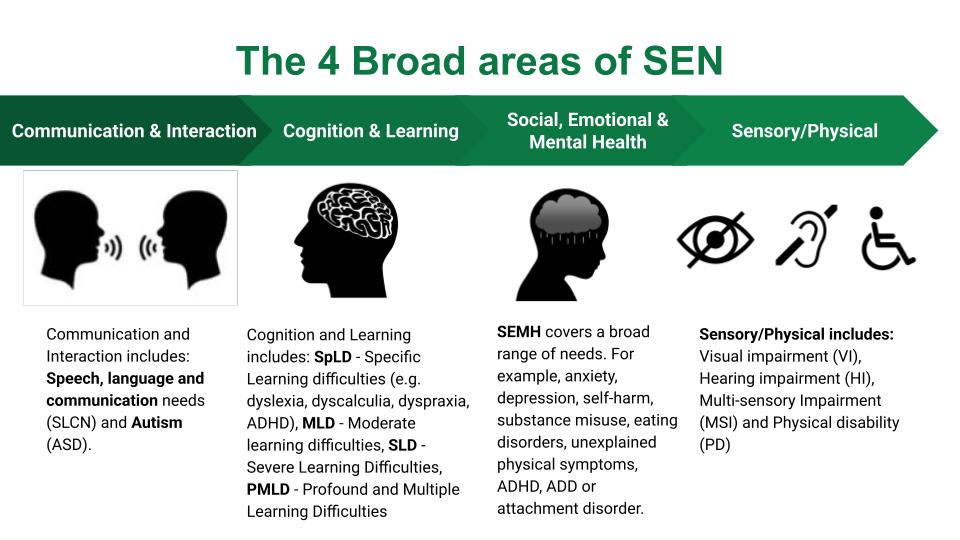
Where students require short-term intervention programmes to eliminate barriers, the academy has explicit provisions mapped across the four broad areas of need:
Cognition and learning:
Read Write Inc. (RWI) Fresh Start literacy programmes for reading catch-up; core vocabulary pre-teaching via structured homework modules; KS4 overlearning sessions through extended school days; and independent learning clubs across mornings, lunch, and after school.
Communication and interaction:
Language for Behaviour and Emotion; speech and language programmes such as Verbo; highly structured and routine-based academy environments to aid regulation; and structured board games clubs for social skill cultivation. Social, Emotional and Mental Health (SEMH): Safe designated intervention spaces inside the academy for external practitioners (CAMHS, Talk Well); mindfulness strategies, solution-focused therapy pathways, and direct psychotherapy programmes.
Physical and sensory needs:
Full accessibility across school grounds; tailored equipment provision (word processors, reading pens, assistive software); and customised adaptive lesson planning within physical education (PE).
Specialist support (Wave 4/Statutory Frameworks)
For pupils with severe or enduring complex needs, we collaborate directly with external support services including Educational Psychologists (EP), the Advisory Teaching Service (ATS), Speech and Language Therapists (SALT), and Occupational Therapists (OT). Teaching assistants provide targetedone-to-one assistance as explicitly mandated and funded within a student’s statutory EHCP framework.
Staff traininand core resource links
All SEND staff complete specialised professional development training pathways across core domains of SEND to continuously scale department depth. Staff are additionally integrated into whole-school pedagogical training frameworks. Dedicated specialists are explicitly deployed to handle Mindfulness, English/Maths catch-up, and Speech and Language (SAL) pathways.
Useful links
Teacher Handbook: SEND
With contributions from specialists across the sector, the handbook is a comprehensive resource for teachers and parents to use over time. It brings together practical examples of high-quality teaching – placing focus on removing barriers to learning, getting to know and understand individual learners, and bringing to life the graduated approach.
To access this free resource, click on the link below and sign up to Whole School SEND:
Whole School SEND Online CPD Units
Free, flexible online learning to help develop inclusive practice.
Link to the SEN Information Report
https://www.greenshawlearningtrust.co.uk/attachments/download.asp?file=4069&type=pdf
Link to the Local Offer
https://www.glosfamiliesdirectory.org.uk/kb5/gloucs/glosfamilies/family.page?familychannel=2_1